Is the Yamaha P-143 Any Good? – P-143 review

The Yamaha P-143 replaced the Yamaha P-45 back in 2023, and it continues to be an outstanding budget piano. In this Yamaha P-143 review, I examine this piano’s affordability, sound and touch quality, connectivity options, and why it’s a great choice for beginners.
Why the Yamaha P-143 is Great
The Yamaha P-143 is an 88-key portable digital piano designed with beginner pianists in mind. In my original Yamaha P-45 review, I praised the P-45 for being a “perfect” entry level piano.
I’m happy to report the Yamaha P-143 continues the tradition of bridging simplicity and high quality without a high price tag.
The Yamaha P-143 is priced at just $499, which gives beginners a low barrier to entry. The P-143 is also slimmer than other pianos in its class, making it lighter and more portable.
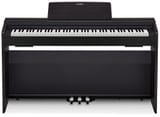
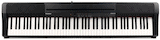
Below, check out how the Yamaha P-143 compares to other notable pianos on the market:
| Photo | Model |
|---|---|
 | Yamaha P-143 |
 | Casio PX-870 |
 | Alesis Prestige Artist |
 | Casio PX-S3100 |
 | Casio CDP-S360 |
Key features of the Yamaha P-143:
- 88 Graded Hammer Compact (GHC) keys
- Yamaha CFIIIS grand piano sampling
- 64-note polyphony
- 10 built-in voices
- USB to Host (MIDI and audio)
- Smart Pianist app compatibility
- Weighs about 24.5 lbs (11.1 kg)
Key Action Gets Big Upgrade Over P-45
One of the biggest things that’s worth noting is that the P-143 features the Graded Hammer Compact key action (or GHC). This is a slightly different key action from the P-45, which featured Graded Hammer Standard (GHS) action.
While both key actions are meant to give the user a realistic piano playing experience, the GHC action utilizes smaller internal mechanisms.
Ultimately, this allows the P-143 to be a slimmer piano, and weigh 1 lb less than the P-45.
The same great keys are here in the P-143, too. The 88 keys are graded, so the higher keys will feel lighter to the touch, while the lower keys feel heavier under your fingers. For beginners, this helps develop proper finger strength and technique.
If your previous keyboard had less than 88 keys, or didn’t have weighted or graded keys at all, you’ll immediately notice the jump up in quality and authenticity with the P-143.

Below, please check out some the best selling digital pianos currently on sale:
| BEST SELLERS |
|---|
| 1) Yamaha P225 |
| 2) Yamaha P-71 |
| 3) Casio CDP-S160 |
| 4) Roland FP-30X |
| 5) Casio PX-870 |
Sound Quality That’s Surprisingly Good

For a beginner-level piano, I love the sound of the P-143. It the amazing Yamaha CFIIIS grand piano sample, a recording of one of Yamaha’s renowned concert grands. The tones are warm, expressive, and responsive to how hard or soft you play.
In total, the P-143 offers users 10 sounds, including the electric piano, pipe organ, harpsichord, vibraphone, and strings.
The built-in stereo speakers (2 x 7W) are located at the back of the piano. I found that they are loud enough for practice and everyday use.
You can also place your piano closer to a wall, allowing the sound to vibrate off the wall and sound louder in the room. Of course, you can also plug in a pair of headphones if you’re practicing at night, as well.
Features and Connectivity Options
The Yamaha P-143 features Duo Mode, which can be an excellent teaching and learning tool. Duo Mode allows two people to sit at the P-143 side by side. The keyboard is then split down the middle, providing the same register on the top and bottom.
This is very helpful for beginners, as Duo Mode allows a teacher to sit and play directly next to his or her student. Ultimately, it’s a very educational mode, and ideal for anyone looking to improve their piano skills.
Another great educational tool I love using with the Yamaha P-143 is the Smart Pianist app. This app is available on both android and Apple devices.
You can open the app on a tablet, for instance, and connect the tablet to the P-143 via the USB to Host port on the back of the piano.
From there, you can use the Smart Pianist app to control how your piano works and sounds. You can change the touch curve, environment, or piano sounds for instance, and the larger screen gives excellent interactivity with the P-143 that otherwise wouldn’t be possible.
Overall, the Smart Pianist integration with the Yamaha P-143 makes an already great piano all the more helpful and easy to use.
The Yamaha P-143 also supports a single sustain pedal. Unfortunately, it does not support a three pedal unit.
Yamaha P-143 vs Yamaha P-45

The Yamaha P-143 and Yamaha P-45 look similar to one another, but there are some pretty big differences.
First, the Yamaha P-143 supports the Smart Pianist app, while the P-45 does not. That’s very important if you’re looking to learn the piano, improve your current skills, or want to control the piano via your phone or tablet’s touch screen.
Another major difference is the pedal options for these pianos. If you want to use a three pedal unit like the Yamaha FC35, you have to buy a Yamaha P-45. The FC35 will not work with the Yamaha P-143, as the P-143 only supports a sustain pedal.
Lastly, while the P-143 and P-45 have similar key actions (Graded Hammer Compact for the P-143 and Graded Hammer Standard for the P-45), the P-143 weighs 24 lbs, while the P-45 weighs 25 lbs.
| Yamaha P-143 | Yamaha P-45 |
| GHC key action | GHS key action |
| 64 polyphony | 64 notes polyphony |
| Yamaha CFIIIS Sample | AWM Stereo Sampling |
| USB to Host | USB to Host |
| 2 x 7W | 2 x 6W |
| 11.1 kg / 24.5 lbs | 11.5 kg / 25.4 lbs |
| ✅ Better action and app support | ❌ Older entry model |
Yamaha P-143 vs Other Beginner Digital Pianos
If you’re comparing the P-143 to other beginner models, here’s a quick summary:
Yamaha P-45: The P-143 is a clear upgrade in touch and feel. It also has Smart Pianist app support. If you need three pedal support, however, the P-45 wins.
Yamaha P-125: The P-125 offers more sounds and features, but is slightly heavier and more expensive. You can also read my Yamaha P-125 review for more information.
Casio CDP-S160: Similar price and lighter, but has a different key feel and no app integration. You can also read my comparison review between the Casio CDP-S160 vs Casio CDP-S110 for more information.
Roland FP-10: Better key action and has Bluetooth MIDI, but often priced a bit higher. You may also want to read my comparison of Yamaha vs Roland digital pianos here, as well.
Overall, the P-143 strikes a very nice balance between high quality and simplicity.
Is the Yamaha P-143 a Good Piano?
Yes absolutely, the Yamaha P-143 is a good piano, especially for beginners. The Yamaha P-143 delivers a realistic piano experience in a compact and affordable package.
Its updated GHC key action, clean sound engine, Duo Mode and Smart Pianist app integration makes this an excellent choice for anyone just starting out.
In this Yamaha P-143 review, we looked at its strengths, limitations, and how it compares to other beginner models. If you’re looking for your first digital piano, and want something that feels close to an acoustic piano for less than $500, the P-143 should definitely be on your shortlist.
You can read more digital piano reviews here.