Yamaha DGX-670 Review – Worth the Money in 2025?
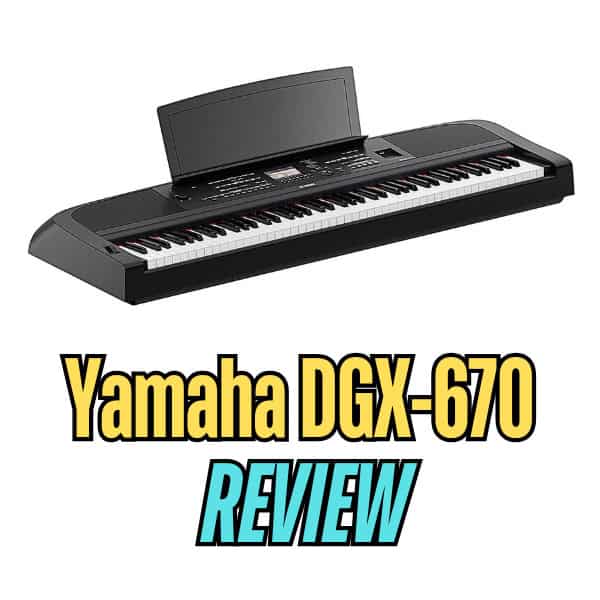
If you’re in the market for a powerful, all-in-one digital piano that blends authentic piano sound with hundreds of features for learning and creativity, the Yamaha DGX-670 is likely on your shortlist.
When I was looking for a powerful digital piano and arranger keyboard that I could rely on, I kept coming back to the DGX-670. So in this review, I’ll share whether I think this piano will fit in with your skill level, goals, and budget.
I’ll also compare it to the Yamaha P-225 and Roland FP-30X, as well.
Design & Build Quality
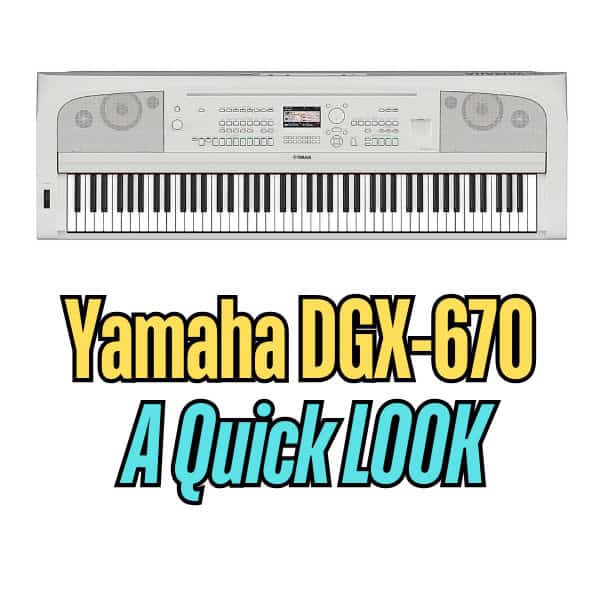
The Yamaha DGX-670 sits in a unique space. It’s a full-sized 88-key digital piano that weighs just over 47 pounds.
The overall build quality is solid, with a sleek matte finish and an intuitive button layout surrounding the large, full-color LCD screen. This display gives you real-time visual feedback, including notation and lyrics. If you’re new to the world of pianos, this is a very helpful feature.
The Graded Hammer Standard (GHS) key action mimics the feel of an acoustic piano, with heavier keys in the lower register and lighter keys in the upper. It’s not the best key action Yamaha offers, but it’s a good choice for beginners and intermediate players seeking realistic resistance.
A step up from GHS is an action called GrandTouch-S. This action features wooden keys on the keybed, pushing the touch and feel of the keys closer to what grand pianos have. A piano such as the Yamaha P-525 features GrandTouch-S action, and is overall a step up in quality from the DGX-670.
| PHOTO | PIANO |
|---|---|
 | Yamaha DGX 670 |
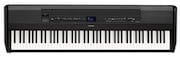 | Yamaha P-525 |
 | Roland FP-30X |
 | Yamaha P-225 |
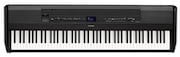 | Roland FP-90X |
Sound Quality & Voices
The DGX-670 uses sound sampled from the excellent Yamaha CFX Grand Piano, delivering rich and nuanced grand piano tones.
You also get access to over 600 voices here, including electric pianos, synths, strings, brass, and world instruments. Compared to the Yamaha P-225 (which has around 24 voices) or the Roland FP-30X (about 56), the DGX-670’s versatility is unmatched in this price range.
Speaker power is impressive, too. The DG-670 features two 12cm speakers powered by dual 6W amps. This powerful system provides a full, well-rounded sound suitable for home environments.
If you need more volume or fidelity, you can even plug in external speakers or use headphones for added privacy.
Performance and Learning Features
Where the DGX-670 really excels is in its accompaniment and learning tools, making it a contender for the best digital piano for beginners who want to grow musically without getting bored.
First, the piano includes over 260 auto-accompaniment styles across pop, jazz, Latin, classical, and more. It can turn simple chord inputs into full arrangements with bass, drums, and harmony.
Even if you don’t know how to play full chords, Smart Chord allows you to play with one finger while the DGX-670 fills in the harmony.
You can also record your own music directly to USB in audio or MIDI format, making it great for songwriting or tracking your progress over time.
| PHOTO | PIANO |
|---|---|
| Yamaha DGX 670 |
| Yamaha P-525 |
| Roland FP-30X |
| Yamaha P-225 |
| Roland FP-90X |
Accessories for the DGX‑670

While the DGX‑670 can work as a standalone keyboard, we recommend a few accessories to enhance your setup:
| Accessory | Notes |
| Yamaha L‑300 Stand | Matches the DGX‑670 perfectly |
| Yamaha LP‑1 Pedal Unit | Adds soft/sostenuto pedals for classical use |
| Bench | Choose an adjustable padded model |
| Headphones | Look for closed-back, neutral studio models |
| USB Flash Drive | Required for saving audio/MIDI recordings |
| Dust Cover | Helps protect your keyboard between sessions |
Connectivity and App Integration
The DGX-670 offers modern digital piano connectivity options that enhance both learning and performance:
USB to Host & USB to Device: Use the DGX-670 as a MIDI controller or transfer audio recordings via USB.
Audio Input: Plug in your phone or tablet and play along with your favorite songs.
Bluetooth Audio: Although it doesn’t support Bluetooth MIDI, it does allow for audio playback from your smart device.
Smart Pianist App: Works with Yamaha’s app for easier navigation, voice editing, and accessing PDF scores or chord charts.
How It Compares to Other Digital Pianos
Here’s a side-by-side look at how the DGX-670 stacks up against two popular competitors:
| Yamaha DGX-670 | Yamaha P-225 | Roland FP-30X |
|---|---|---|
| GHS Weighted | GHC Weighted | PHA-4 Standard |
| 600 voices | ~24 voices | ~56 voices |
| 256 notes polyphony | 192 notes polyphony | 256 notes polyphony |
| Smart Pianist App | Smart Pianist App | Piano Every Day |
| USB Audio/MIDI | MIDI only | USB Audio/MIDI |
| $850–$950 | $650–$750 | $750–$850 |
Verdict:
The Yamaha DGX-670 clearly outclasses both the Yamaha P-225 and Roland FP-30X in terms of features and versatility. While the P-225 is cheaper, lighter, and more straightforward, it lacks the DGX’s learning tools and wide voice palette.
The Roland FP-30X, on the other hand hand, has a slightly more realistic key action, but doesn’t match the DGX in terms of built-in content or visual interface.
Pros and Cons of the Yamaha DGX-670
| Pros | Cons |
| Authentic CFX grand piano tone | Heavier and bulkier than portable models |
| Extensive voice and accompaniment library | GHS action less advanced than Roland’s PHA-4 |
| Built-in learning tools and Smart Chord | No Bluetooth MIDI |
| USB audio recording and app support | Console-style design may not appeal to everyone |
Who Should Buy the Yamaha DGX-670?
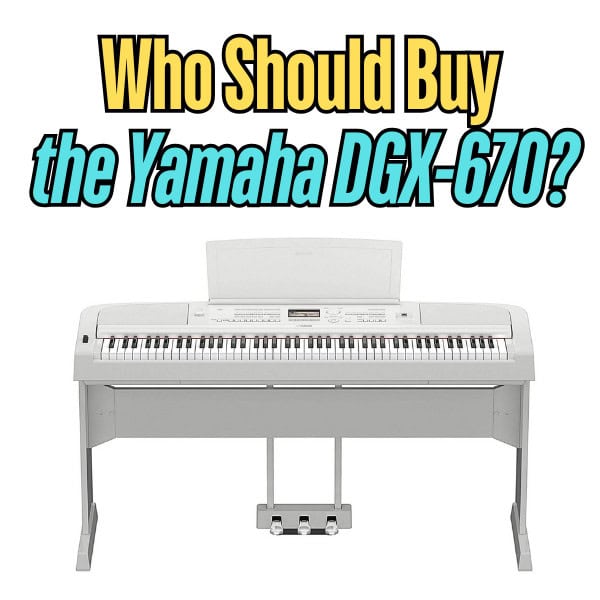
The DGX-670 is ideal for:
1) Beginners who want to learn at their own pace using onboard lessons and accompaniments.
2) People looking for a digital piano that also functions as an excellent arranger.
3) Hobbyist players who want hundreds of sounds and rhythms to explore creatively.
4) Intermediate players who want an authentic feel and recording capabilities without spending $1,500+.
It’s less ideal for gigging musicians or those needing ultra-portability; in that case, consider a model like the Roland FP-30X or Yamaha P-125.
Is the Yamaha DGX-670 Worth the Price?
At around $850–$950, the DGX-670 falls in the upper-midrange for digital pianos. But when you factor in the feature set, such as weighted keys, hundreds of voices, recording options, Smart Chord, and learning tools. The answer biomes clear: the Yamaha DGX-670 offers the best tools and overall value.
In fact, if you were to buy a basic digital piano, a MIDI controller, and learning software separately, you’d likely spend more and still not get the integration the DGX-670 offers out of the box.
You can also find more of my digital piano reviews here.